Saturday, April 23, 2011

Top Five ways to improve your tone

In honor of the movie (and book) High Fidelity here are the top five ways to make your electric guitar or bass sound better.

5.  electronics- 
this Stratocaster pickguard has copper shielding tape, 250k CTS pots, .022 uf orange drop capacitor, 5-way switch, cloth-covered wire, and Schuyler Dean pickups

This includes pots, capacitors, switches, jacks and shielding.  If you're building a guitar it is a good idea to not skimp on this part and if your doing something like installing new pickups it's nice to use quality electronics to carry the current.
  • Shielding- it is important to have shielding grounded properly and surrounding the entire control cavity so that outside electrical interference can't get in.  typically luthiers use shielding paint on the wooden cavity grounded by a lead wire, and shielding tape on the back of the pickguard.  Everything is grounded in this circuit; the pots touching the pickguard shielding, the metal covers on humbuckers, and even the braiding on 2-conductor wire.  A wire is then run from the back of the pots to the bridge grounding the strings.  Ever notice how when you touch the strings the amp stops humming?
  • Potentiometers (pots)- 250K pots are warmer and typically used for single coils and 500K pots are brighter and typically used for humbuckers.  No-load pots are louder and make the guitar sound brighter.  There are endless possibilities.
  • Capacitors (caps)- The higher the number, the more bass at the zero setting on your tone control.  A .100 uf cap will sound warmer than a .001 uf cap.  Again the possibilities are endless.
4.  The Nut-
 a bone nut in a Fender P-Bass

This piece of shaped plastic or bone holds the strings in place at the zero fret for the correct string spacing.  Most are made of inexpensive plastic but you can get a nicer tone from bone or even brass for killer sustain!  You can only hear the difference when the strings are being played open of course.


3.  The Bridge-
the Stratocaster tremolo pivots on six body screws and is tensioned by three 
to five springs mounted on the bottom of the body.

There are many different types from the tremolo to the string-thru-body and they all add a bit of character to your guitar.  Brass saddles will typically sound a little nicer than cheaper steel ones.

2.  Pickups- 
Jazzmaster pickups get their fat tone from short "pancake" style 
bobbins and plenty of winds of copper wire.

All pickups really do is change string vibration into an electrical current, but they have everything to do with your guitar tone and how it behaves through the amp.  Good quality pickups like the ones I make will sound clearer and have more voice and character than cheap ones.  High-output pickups will be louder and produce more lows than brighter low-output pickups.

1.  Strings-

And the number one best way to improve your tone (aside from practicing) is to use new, high-quality strings.  Strings with more nickel will sound warmer, and strings with more steel will sound brighter.  You can also opt for flatwounds for an even warmer tone.  Larger diameter strings like .011's (on six string guitar) will be louder and warmer because there is more mass moving for the magnetic pickup to detect.  Old, dirty strings will not perform as well and sound dead so it is important to keep your strings clean and change them regularly.

Monday, April 11, 2011

Bass Pickup Test

Can better pickups really make a cheap guitar sound more high-end?


 I've been wanting to try this test for quite a while now, doing a controlled experiment where all the variables are the same to test the difference between stock pickups and high-quality ones like mine.  For this test I acquired a fairly run-of-the mill P-Bass copy with a maple neck, rosewood fretboard, some sort of inexpensive body wood like basswood or laminate, and standard electronics. Cost: $100.

I started by recording the stock bass via direct input to my M-Audio Firewire.  I recorded in ProTools and just used some simple compression and a little bit of reverb to give it some depth.  I did a simple riff (forgive my sloppy playing) first with a pick and then switched to fingers.


Next I took apart the bass and took out the old Select by EMG pickups.  Output was 7.6k and magnetic pull was over 50 Gauss per coil.


I replaced these with a set of my vintage-spec pickups with Alnico V magnets hand beveled and hand weakened to 25 Gauss.  They are scatterwound with 42 gauge Formvar wire with 10,000 winds per coil, yielding a little over 10k of output.  I top it off with wax potting in the proper mixture of beeswax and paraffin and wire it all up with vintage-style cloth covered push-back wire.  Truly the cream of the crop.  Total cost of the bass with my pickups: $200.


I wired everything back up and restrung the guitar with the same strings and recorded the same riff with the same software and the same compression and reverb and you can hear the results below in the two mp3 files. It helps to listen with some high-quality headphones.

First you will hear the guitar with the stock EMG pickup, it's a cheap pickup and sounds about as it should.

Stock Pickup
Next you hear my vintage-spec P-Bass replacement.  First, pay close attention to the extreme highs and you will notice even the most subtle sounds of the fingers moving over the roundwound strings, something you can't even hear from the EMGs.  This clarity and response of my pickup is a result of scatterwinding, this lowers the distributed capacitance of the pickup.  Now listen to the extreme lows and you will hear nice round, organic low notes where the EMG is flabby.  If you listen to the track again and this time listen to the mids and you will hear all kinds of character and life where the EMG's are obviously lacking.  A guitar should have a "voice" and not just sound like a P-Bass, the mids are where this character lies.  The Sklar pickups hear this voice very well and it comes through organically whereas the EMGs sound harsh and metallic. 

My Pickup

The clarity and character of the Schuyler Dean pickup comes from the select components that I use and the quality of the craftsmanship.  They say a band is only as good as its worst player, and that is true with pickups as well.  If every piece of the puzzle is a good one then the results will be good.

Tuesday, March 29, 2011

The Best of Both Worlds

Humbuckers are used for their ability to "buck" hum and also for their fat tone.  Many modern humbuckers come with extra lead wires so that they can be custom wired to switch between single coils and humbuckers via a push-pull pot.  The only problem is that when you take a humbucker with an 8k output and switch to single coil mode you literally cut the output in half to about 4k because you are only using half of the pickup.  A 4k single coil is a pretty weak single coil, and you will notice the tone will be quite thin and unexciting.  

One way of fighting this problem is to wind the coil on the adjustable side to a higher output.  At Sklar we use special 43 gauge wire to wind the adjustable screw side of the pickup to 6k in the neck and 7k in the bridge, similar to what you would find in a strat.  The slug side of the pickup is wound normal and when you switch back to humbucker mode you get nice fat tone with no hum.  You can custom order a set of these pickups with your choice of covers for a special price of $200 for the month of April only!  Email sklarguitars@gmail.com to place your order.

We teamed up with Aaron and James of Maret Guitars to install a set of these in their Custom Classic and we were very pleased with the results.  This guitar has an alder body, a special wide maple neck, ebony fretboard, push-pull coil tap switch, string-thru-body bridge, pearl white finish, and a snappy two-piece tortoise pickguard.  The guitar is on display at SF Guitarworks in the Potrero Hill neighborhood of San Francisco and you can come by and see it yourself and even try it out.  Make sure to talk to Aaron while you are there.

Tuesday, October 19, 2010

How does a truss rod work?

The truss rod makes adjusting the bow in your neck possible.  They can be found in all modern electric, acoustic, and bass guitars.  some vintage guitars didn't come with a truss rod, but that's ok, as long as the action is not too low or too high.

Strings put a lot of tension between the tuners and the bridge, so naturally the neck will bow a little under the force, a little bow in the neck is a good thing.  Unfortunately wood is prone to warping due to temperature and humidity changes and can bow too much causing high action or even back-bow making the action too low and causing fret-buzz. 

A truss rod is a metal rod that runs up the length of the neck under the fingerboard and has a nut at one end for adjustment.  There are many different types of truss rods but one of the most common is the twin-action truss rod shown below.  They make it possible to adjust for either bow or backbow.


The twin-action rod is two threaded rods connected to blocks at both ends.  At one end there is a nut for adjustment, if you turn the nut clockwise it shortens the bottom rod and forces the rod and the neck to bend backwards and correct bow.  If you turn the nut counter clockwise it lengthens the bottom rod and forces the neck and the rod to bend forwards and correct backbow.  Here is a picture of how the truss rod fits in a small channel routed in the neck under the fingerboard.


The other type of rod is a single-action rod that only corrects for bow in a neck.  This type of rod requires a curved truss rod channel.  The rod itself (shown in green) is curved and when you tighten the nut it forces the rod to try to straighten out, thus straightening out the neck and correcting for too much bow.


Generally to adjust a truss rod you need to make very slight adjustments at a time, you may not even see results for 24 hours after the adjustment is made.  Go slowly to avoid breaking your truss rod, it is a very expensive repair.

For more information on how to set up your guitar, see our setup blog entry.

Wednesday, September 22, 2010

Custom Pickups!

build pickups to your personal specs!


Pickups have a lot to do with the sound of an electric guitar and how it behaves through an amp and they are usually one of the first places guitar makers cut costs when they are designing entry-level guitars.  That's why pickups are the first thing you upgrade when you're searching for better tone, and they are usually much cheaper than buying a better guitar.


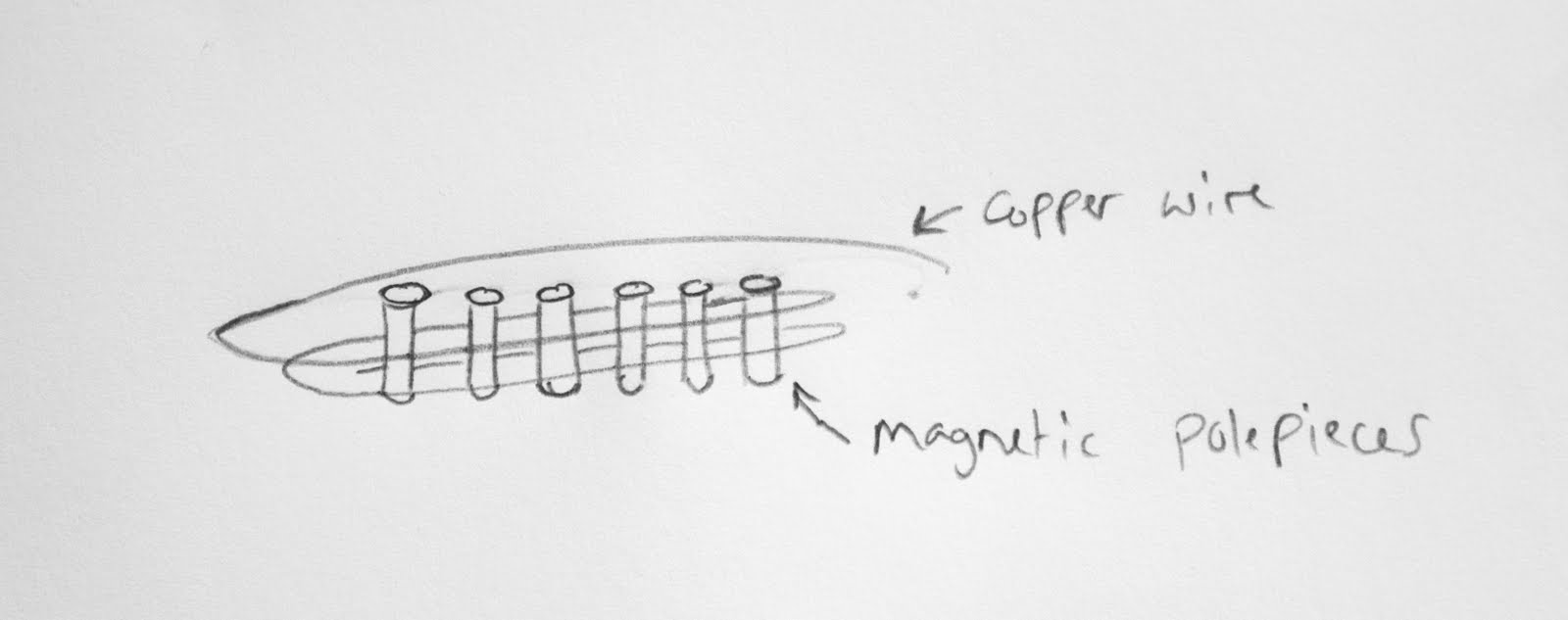
They simply consist of magnetic polepieces wrapped in thousands of winds of copper wire.  The type of magnets and wire obviously have a lot to do with the tone, but so do the winding style, number of winds, and type of material used to pot them (see: wax potting).  Below you will find a short list of what goes into building a pickup and the effect it has on the tone.  All of these components are ones that were used on early Gibson and Fender pickups to produce the legendary tones that they are famous for today.  I tested all of these different materials and methods myself with the pickups I built as well as consulted the fine people at SF Guitarworks and Mojotone to come to the conclusions that I made.  Read through this short list before ordering your new set of pickups through our website and you'll be a pickup expert too. 

Magnets

Alnico V-  by far the most popular magnet for vintage-style pickups.  Drives your amp harder to break up sooner, lowers headroom.  Tight punchy lows, low to moderate mids, singing highs.

Alnico III-  the brightest of the alnico magnets.  Lower output than Alnico V.  Used in very early Teles and Strats from the 50's.  Nice round highs and a strong midrange with good bite.

Alnico II-  spongy attack.  Smooth highs and strong mids. Lower output than Alnico V.  Used in Gibson PAF humbuckers and some P-90's.


Wire

Formvar- common in vintage Fender pickups.  Warm and smooth sounding.

Single Build Plain Enamel- also used in many vintage Fender pickups, useful when squeezing a maximum number of winds on the coil.  Aggressive and sharper on the bass and treble response.

Polycoated- darker sounding overall.  Great when used in high output pickups for smoothing out harshness.

Construction Techniques

Scatterwinding- All of our single coil pickups are scatterwound, it is widely known in the pickup building world that scatterwinding is the best technique for building pickups because of the increased clarity and response to subtle details.  It really opens up the sound.  For more information see my blog entry on Scatterwinding.

Overwinding by 5%- some blues and rock players prefer pickups that drive their amp harder for more breakup through the amp.  Overwound pickups also produce 5% more bass and 5% less treble.  The high strings will sound fuller and sweeter but the wound strings will sound darker.

Underwinding by 5%- If clarity is your goal then underwinding is ideal.  It produces 5% less bass and 5% more treble and makes your wound strings sound clearer.  

Wax Potting-  If you are using gain or excessive volume in your rig it is highly recommended that you order your pickups with wax potting.  The hardened wax holds the windings together to keep them from vibrating against each other and causing feedback and microphonics.  On the contrary, early Fender pickups were not wax potted and some are regarded as being some of the best sounding in the world, pickups without wax are generally more open sounding.  For more information please see my blog entry on wax potting.  All of our pickups are wax potted unless otherwise stated.

Staggered/Flat polepieces-  Most modern pickups are staggered to compensate for fretboard radius and varying string-to-string balance in volume.  You may opt for flat polepieces in your setup.  Most Telecaster bridge pickups have flat polepieces and they sound just fine.  All of our pickups have staggered polepieces unless otherwise stated.

Beveled Polepieces-  beveling the edge of the polepiece makes them look a little nicer.  Some say that it smooths out the tone of the pickup as well.  All of our Stratocaster, Jazzmaster, Jaguar, P-Bass, and Jazz Bass pickups have beveled polepieces unless otherwise stated.

Monday, August 16, 2010

Trick/Retro Tele

A classic guitar with a few trick modifications


We just finished this demo Telecaster that will make its home in Gary Brawer's repair shop in downtown San Francisco.  If you would like to try this baby out, just visit Gary's shop in the back of Real Guitars, 15 Lafayette St. (at the corner of Mission).  


It was designed much like a 50's Reissue, with lightweight swamp ash body, vintage-style three saddle ashtray bridge, and a maple neck from a MIM Fender Telecaster.   The body was made completely from scratch from a nice piece of ash from Stewart Macdonald.  I wanted to forgo the pickguard and really let that beautiful wood grain show through, so I decided against the common routing in the body for the wiring that typically hides under the pickguard.  The wiring in this guitar is routed through a small hole starting at the neck pocket and ending in the control pocket. With amber stain and a thin coat of waterbased varnish this guitar is a real beaut!


Trick electronics include our hum-canceling bridge pickup to get rid of that pesky 60-cycle hum, and a 4-way switch so that you can play with the two pickups wither in paralell (standard Tele wiring) or in series (more output, fat sound).  The neck pickup is a special custom creation of mine that has the perfect balance of trademark "bell" tone, shimmering highs, and voice in the lower mids.  The electronics are topped off with a pair of vintage "chickenhead" volume and tone control knobs I found at a yard sale.  


Tuesday, August 10, 2010

The hum-canceling Telecaster bridge pickup

single coil sound with the ability to "buck" hum!

Anyone who plays a Tele knows that they are vulnerable to interference and thus create a lot of hum through the amp.  Single coils naturally create a 60 cycle hum and there is no way around that.  Some companies offer solutions like samamium cobalt noiseless pickups, or stacked humbuckers, but usually at the cost of tone.  Some guitars with two pickups can be wired out of phase to cancel hum between the two pickups, but on a Telecaster even the middle position on the pickup selector offers no hum-canceling effect.  That's because both coils are wound counter-clockwise and the poles are charged North-up, partly because hum-canceling technology was non-existent in the 50's and partly because that middle position tone has become such a trademark of the Tele tone.

One of the best ways to combat hum and still keep the single coil tone is to have a split-single coil wired out of phase, like a P-Bass pickup.  What I have created here is essentially a P-Bass pickup that looks and sounds like a Telecaster pickup.  One coil is wound counter-clockwise and is charged North up and the other is wound clockwise and is charged South up.  They are then wired out of phase to cancel hum.  All of the normal Tele characteristics like a copper-plated steel baseplate, cloth-covered leads, and vintage-style flatwork are included.  I don't want to give the impression that I was the first one to do this, but this is not something you can just walk into Guitar Center and buy.  They are wound to 7k and are available for Teles for $125 each.  Contact me here to order yours.